
Tabula Rasa
In my field experience with digital transformation, innovation is rarely blocked by a lack of ideas or tools. It is more often blocked by a way of thinking that treats inherited processes as if they were natural laws. Procedural thinking is useful, sometimes essential, but it becomes a constraint when it turns into the default lens for every problem. First principles thinking offers an alternative: strip the problem down to what must be true, then rebuild the solution from those fundamentals. The practical value is not philosophical purity. It is the discipline of separating real constraints from accidental ones.
In the real world, the point is not to replace procedures with first principles. The point is to use first principles to audit procedures: which steps are true guardrails, which are coordination mechanisms, and which are inertia dressed up as “best practice.”
Procedural thinking and first principles are both tools
When work is governed by status quo logic, the primary goal often becomes defensibility: every step must be justified by precedent, policy, or history. This produces a linear environment where the original question is rarely challenged. First principles thinking starts from a different assumption: if a constraint is not imposed by physics, economics, law, or safety, then it is negotiable. But in organizations, “negotiable” does not mean “easy.” Some constraints exist because they protect power structures, reduce perceived risk, or prevent coordination breakdown.

Constraint taxonomy map
A balanced view looks like this:
- First principles thinking identifies core components, true constraints, and the few variables that actually drive outcomes.
- Procedural thinking packages hard-won learning into repeatable steps, making coordination possible at scale.
- Questioning the status quo is valuable when it removes steps that no longer serve a functional purpose, but it is dangerous when it removes hidden controls or safety mechanisms.
- Precedent can protect legacy inefficiency, but it can also encode real failure modes learned the hard way.
A practical test I use is simple: if you cannot explain what risk a step mitigates or what outcome it protects, it is likely a candidate for redesign. If you can explain it clearly, then your choice is not whether to keep it, but whether to keep it in its current form and at its current cost.
Analogy is cheap, but not always shallow
In transformation programs, teams often reason by analogy: “This looks like the last program,” “this is how the industry does it,” “we will copy that operating model.” Analogy is cognitively efficient and is often the only way to move quickly in complex environments. The downside is that analogy can lock teams into incrementalism when they rely on surface similarity and stay within the same domain.
At the same time, analogy is also one of the most powerful engines of creativity when it transfers deep structure across domains. The difference is whether the team is copying the visible form or importing the underlying mechanism. Practically, this means: use analogies to generate options, but validate them against first principles before you commit.

Surface vs structural analogy paths
Digital transformation and the friction of the social web
Digital transformation is often described as a technical upgrade. In practice, it is usually a conflict between reality-based problem solving and procedural inertia. Many initiatives stall not because the technology is impossible, but because existing procedures are treated as sacred, and deviations are seen as failures rather than learning.
However, a purely logical approach fails in a different way. Organizations are not mechanical machines. They are complex social webs. People respond to change through incentives, identity, status, and fear of loss. If you ignore that, even a technically correct solution will not land.
Why transformations fall short
In a majority of large programs I have seen, the failure mode is not a total collapse. It is one of these:
- value is created but not at the scale that was promised
- adoption is partial and uneven
- behaviors revert after the program team disbands
- execution drifts, governance becomes performative, and the transformation becomes an internal narrative rather than a market outcome
This is why broad statistics about transformation “failure” can be misleading. “Fail” often means “did not fully meet objectives” rather than “did not ship anything.” A more accurate practitioner statement is: a minority achieve their full ambition and sustain it; many deliver something, but not enough to justify the cost and disruption.
Scope change is not the real problem
In status quo cultures, scope change is framed as a planning failure. In learning cultures, scope change is framed as a response to new information. Both can be true.
- Scope changes are healthy when they reflect real-world feedback and improved understanding.
- Scope changes are toxic when they are driven by politics, lack of decision rights, or unclear outcomes.
Competitive advantage comes from teams that can iterate quickly on real results without turning every change into a loss of face. That requires governance that rewards learning, not only compliance.
The defensibility trap
One of the most consistent patterns in large organizations is a culture of defensibility. When the cost of being wrong is high, people optimize for not being blameworthy according to the rules. This produces delays that are easy to justify and hard to challenge. The organization becomes excellent at explaining why something cannot be done, while losing the habit of testing whether it can.
In practice, this trap is rarely fixed by telling people to “be bold.” It is fixed by redesigning incentives, clarifying decision rights, and creating safe ways to surface problems early.
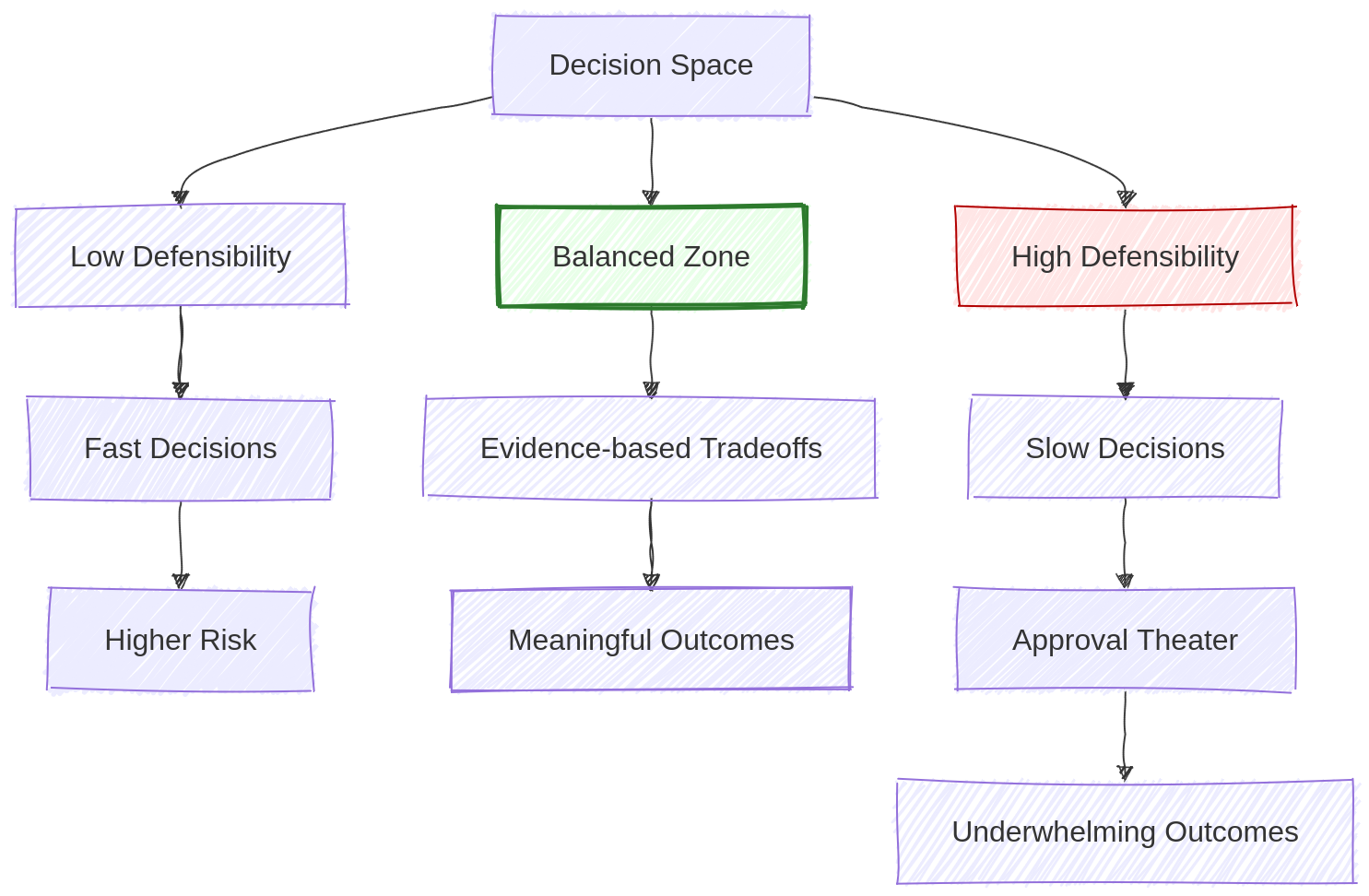
Defensibility vs outcome value tradeoff
The equilibrium of logic and human systems
First principles thinking is a powerful tool for overcoming stagnation, but it has limits in human systems. In complex organizations, friction is not just waste. Some friction is stability. Procedures reduce cognitive load, provide a shared language, and enable thousands of people to coordinate without constant negotiation.
The leadership challenge is to distinguish between:
- Guardrails that protect safety, compliance, resilience, and quality
- Coordination mechanisms that reduce entropy at scale
- Arbitrary hurdles that persist mainly because removing them would trigger political cost
A nuanced transformation approach accepts tradeoffs:
- Too much procedure produces rigidity and slow learning.
- Too little procedure produces chaos, inconsistent execution, and hidden risk.
Constant questioning has a cost
Relentless “why” questioning can lead to decision fatigue and burnout. It can also create permanent uncertainty, which is a tax on execution. The goal is not perpetual redesign. The goal is to create periods of exploration, followed by periods of standardization and scale.
A pattern that works in practice:
- Use first principles to explore and redesign.
- Convert the winning design into clear operating mechanisms.
- Standardize just enough to scale.
- Reopen assumptions only when evidence indicates drift or new opportunity.

Transformation lifecycle loop
Loss aversion is real, but not the whole story
People often resist change because they experience it as a potential loss: loss of status, loss of competence, loss of autonomy, loss of predictability. But it is a mistake to reduce all resistance to one psychological bias. Resistance can also be rational: the proposed change may genuinely increase risk, reduce quality, or shift work onto teams that cannot absorb it.
A mature transformation approach treats resistance as data. Sometimes it reveals self-preservation. Sometimes it reveals a valid constraint you have not modeled yet.
Gaining advantage through empirical inquiry, without breaking the organization
A major barrier to progress is when procedural thinking shifts from being a corrective tool to being a directive one. Rules stop being guardrails and become the strategy. This forces every new idea to fit an old mold.
In my experience, the organizations that move fastest do not “ignore process.” They run a different process:
- they treat the status quo as a hypothesis
- they test constraints rather than argue about them
- they use market feedback and operational telemetry as the judge
- they convert validated learning into scalable mechanisms
Where first principles helps most
The most productive first-principles questions are not abstract. They are operational:
- What outcome are we optimizing for, and how will we measure it?
- Which constraints are truly non-negotiable, and why?
- Which constraints exist because of incentives, ownership, or fear?
- What is the smallest test that will produce real evidence?
This is where first principles becomes pragmatic rather than ideological. It does not replace governance. It makes governance evidence-driven.
Psychological safety is not softness
A final tradeoff is cultural. If you want people to challenge the status quo, you need an environment where it is safe to surface problems, admit uncertainty, and disagree without career damage. But safety does not mean comfort. It means candor. High standards still apply. The difference is that problems are exposed early enough to be solvable.
In practice, psychological safety is a performance tool. It prevents “silent failure,” where everyone sees the issues but nobody says them until it is too late.
Closing perspective: innovation is constraint clarity plus social design
From the field, the lesson is straightforward: first principles can clarify what is possible, but people and incentives determine what is adopted. Procedures can scale success, but they can also freeze the past. Competitive advantage comes from managing these tradeoffs deliberately:
- use first principles to challenge assumptions and reveal real constraints
- use procedures to scale and stabilize what works
- use empirical tests to settle disputes quickly
- design incentives and social conditions so truth can travel without punishment
That is the kinetic power of first principles in organizations: not rebellion against process, but the ability to continuously separate what must be true from what has simply become familiar.